Fluid dynamics, ventilation, CFD and aerodynamics?
Computational fluid dynamics, also known as ‘CFD’, is a tool used to analyse and solve problems related to fluid flow. CFD enables accurate predictions to be made about the flow properties of complex systems, whether they involve liquids or gases, or even phase changes. It is thus possible to study all the interactions between the fluid and its environment.
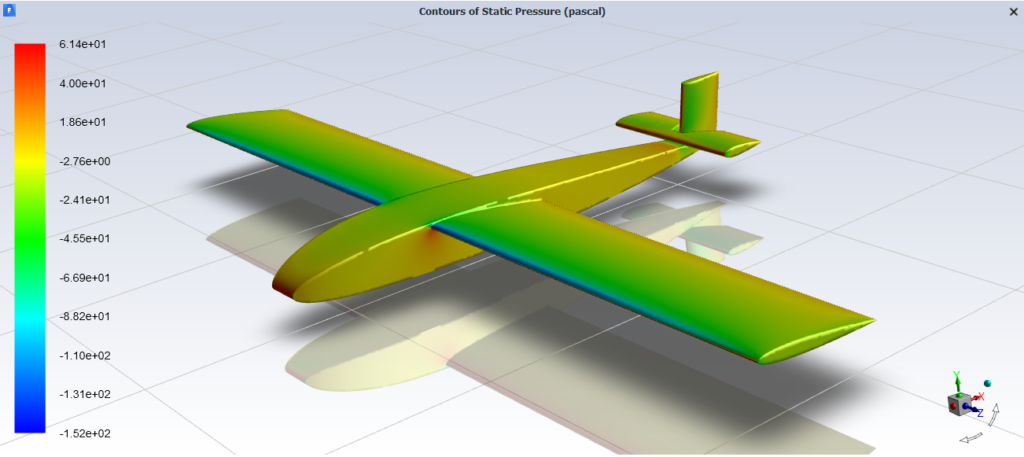
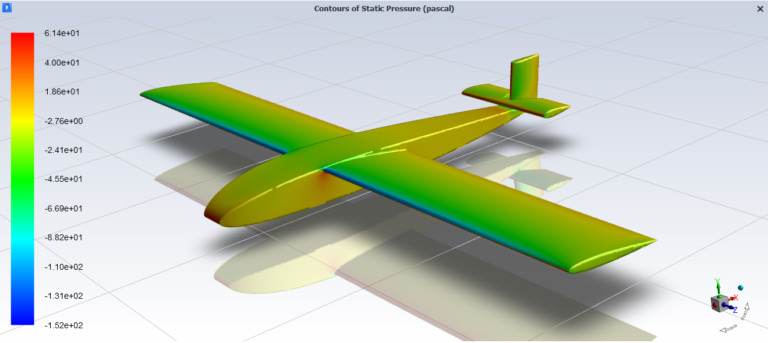
In the image opposite, in the field of aeronautics, pressure has been calculated on the aerodynamic surfaces of a drone. Fluid simulations are used in many other fields; examples include sizing an actuator required to close a valve, assessing pressure losses in a complex flow, or analysing the flow around a radiator.
This type of simulation allows us to analyse a flow without taking the time variable into account. In other words, we seek to stabilise the results both at the macro level and in the localised data. This type of simulation is known as steady-state or steady-flow simulation.
Fluid simulation under transient conditions
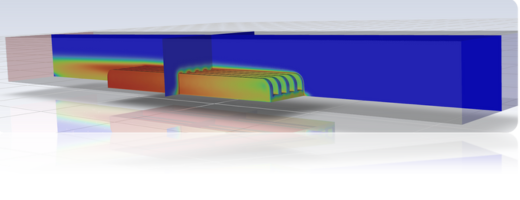
Transient simulations take the variable ‘time’ into account. The analysis will be run to study the flow at a specific time ‘t’. This makes it possible, for example, to determine the velocity at the time (t=20s) following the opening of a valve, the flow rate at another time, and so on.
Linking the analyses
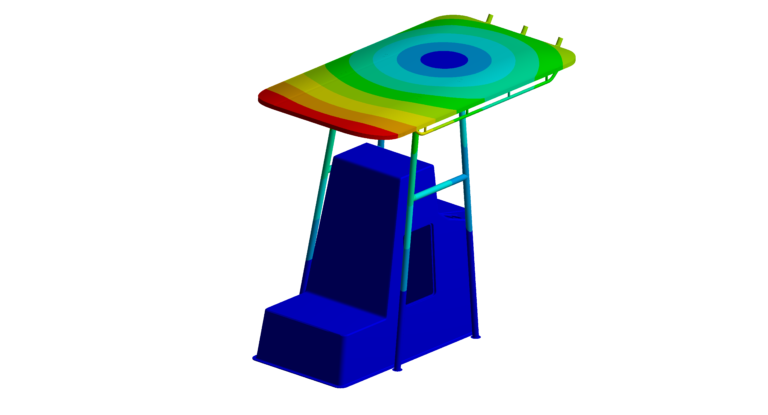
This “fluid simulation” module can be directly applied to our various mechanical, thermal or multiphysics analyses. Taking the aerospace industry as an example, a fluid study can be run on all aerodynamic surfaces, the pressures extracted from it, and these integrated into a mechanical analysis simulation to validate the structural integrity, analyse displacements and deformations, and identify other instabilities.
By continuing to browse this website, you consent to the use of cookies or other tracking technologies to provide you with tailored services and offers
Privacy & Cookies Policy
Privacy Overview
This website uses cookies to improve your experience while you navigate through the website. Out of these, the cookies that are categorized as necessary are stored on your browser as they are essential for the working of basic functionalities of the website. We also use third-party cookies that help us analyze and understand how you use this website. These cookies will be stored in your browser only with your consent. You also have the option to opt-out of these cookies. But opting out of some of these cookies may affect your browsing experience.
Necessary cookies are absolutely essential for the website to function properly. This category only includes cookies that ensures basic functionalities and security features of the website. These cookies do not store any personal information.
Any cookies that may not be particularly necessary for the website to function and is used specifically to collect user personal data via analytics, ads, other embedded contents are termed as non-necessary cookies. It is mandatory to procure user consent prior to running these cookies on your website.